March 4, 2026
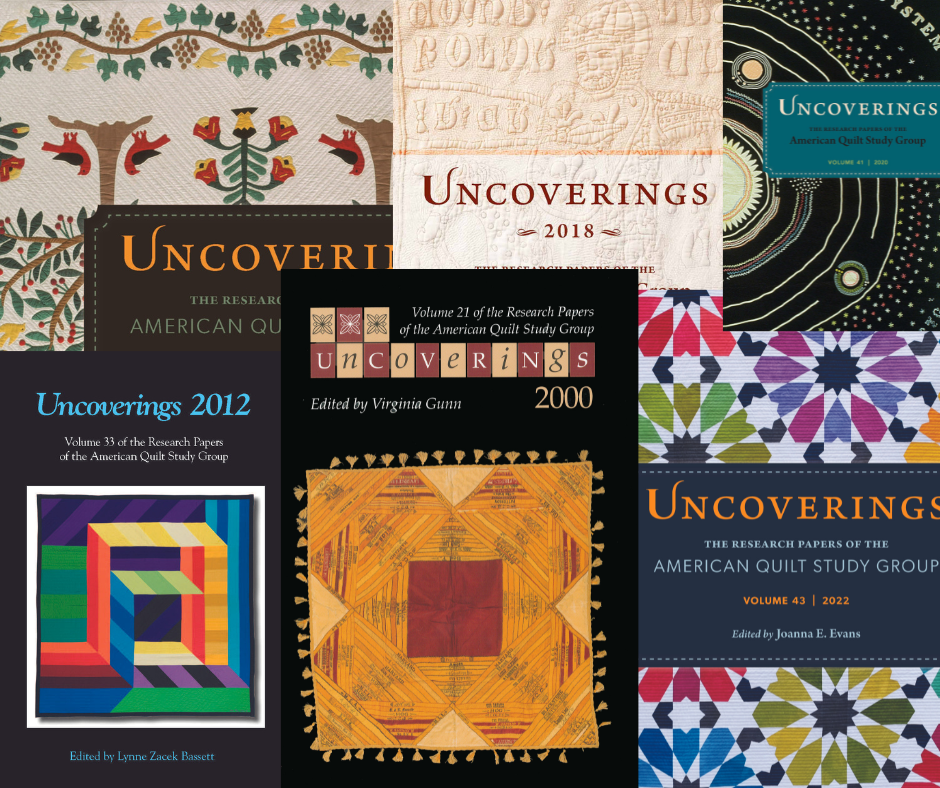
Quilt History Snippets for March, 2026…by Kathy Moore What: Review of Uncoverings 1995, Volume 16 of the Research Papers of the American Quilt Study Group, edited by Virginia Gunn Topic: “Symbiotic Stitches: The Quilts of Maggie McFarland Gillespie and John Gillespie, Jr.” Author: Marlene O’Bryant-Seabrook For all our fellow AQSG members, this article is a good example of how a topic can occur to any of us and take on a life of its own to become an interesting and informative piece of research and discovery. Sometimes it opens one’s eyes and develops a narrative you just have to follow to the end of the process. We need more of this for our journal and our Seminar presentations. The author notes that she reviewed “the literature on Southern African-American matrilineal quilters” in order to discuss “the existence of African males in the textile arts in Africa and during slavery” in order to explain how European gender-role ideology has permeated the African-American male views on quilting and other needle arts.” [p. 175] What follows is authoritative information on individuals, some of whose names you will recognize, and their experiences that enlighten and enliven her narrative. There is a brief description of the experience of male textile artisans in Africa (where they and their work was valued) and in the United States as slaves where “they were forced on the plantations to submit to the division of labor which existed in Europe. African-American males thus began to view all needle arts as ‘women’s work.’” [p. 181] Nineteenth century scientist, George Washington Carver, learned needlework, especially crochet and cross stitch, and was so adept he could copy what he’d seen “without being shown” a pattern. [p. 181] Rosey Grier, a large and intimidating figure on the football field for the New York Giants and the Lost Angeles Rams in the 1970s, was photographed and he discussed in the media his work at needlepoint which he is quoted as saying that “he found … relaxing when he took plane trips and handy as a means of striking up conversations with beautiful women.” When told he had “lost your macho” that “Needlepoint is for sissies” he replied that their “opinions didn’t bother me.” [p. 182] Much of the article focuses on a mother-son team of quilters, Maggie and John Gillispie, Jr., who lived and subsistence farmed in South Carolina. John, Jr. was very attached to his mother and learned many household skills from her including piecing and quilting, much of it without printed patterns and without published pattern names. It’s a story of touching devotion between the two of them and an inspiring story of the restorative therapy provided by their quilting activities over a number of years. Images and direct quotes help enliven the narrative. It is to be noted that this author, based on her research, disputes the assertion of Maude Southwell Wahlman that quilts made by African-Americans were “designed and stitched with African traditions in mind.” Indeed, O’Bryant-Seabrook supports Roland Freeman’s assertion that there is no need to “construe African-American quilts (as being) based on African concepts.” [p. 190] Furthermore, O’Bryant-Seabrook emphatically states that she did not “believe that Maggie and John Gillispie, Jr. felt any visceral cultural rumblings when they planned, pieced, and quilted a quilt.” [p. 190] Finally, O’Bryant-Seabrook declares that “The Gillispie story provides an intimate look into an African-American family in which quilting became more of a bonding experience that a necessity.” [p. 195] As presented, the Gillispie story becomes a case study for all of to learn from. There are many good and informative end notes that validate the research presented in this article. Given the 35+ years since publication of this article, it is one more which could use follow-up research and reporting. Dr. Carolyn Mazloomi and AQSG’s own Laurel Horton were original consultants (and were referenced) for this article and may be good sources for a renewed look at this topic. Hopefully, someone among us will want to pursue this line of inquiry and enlarge upon it.